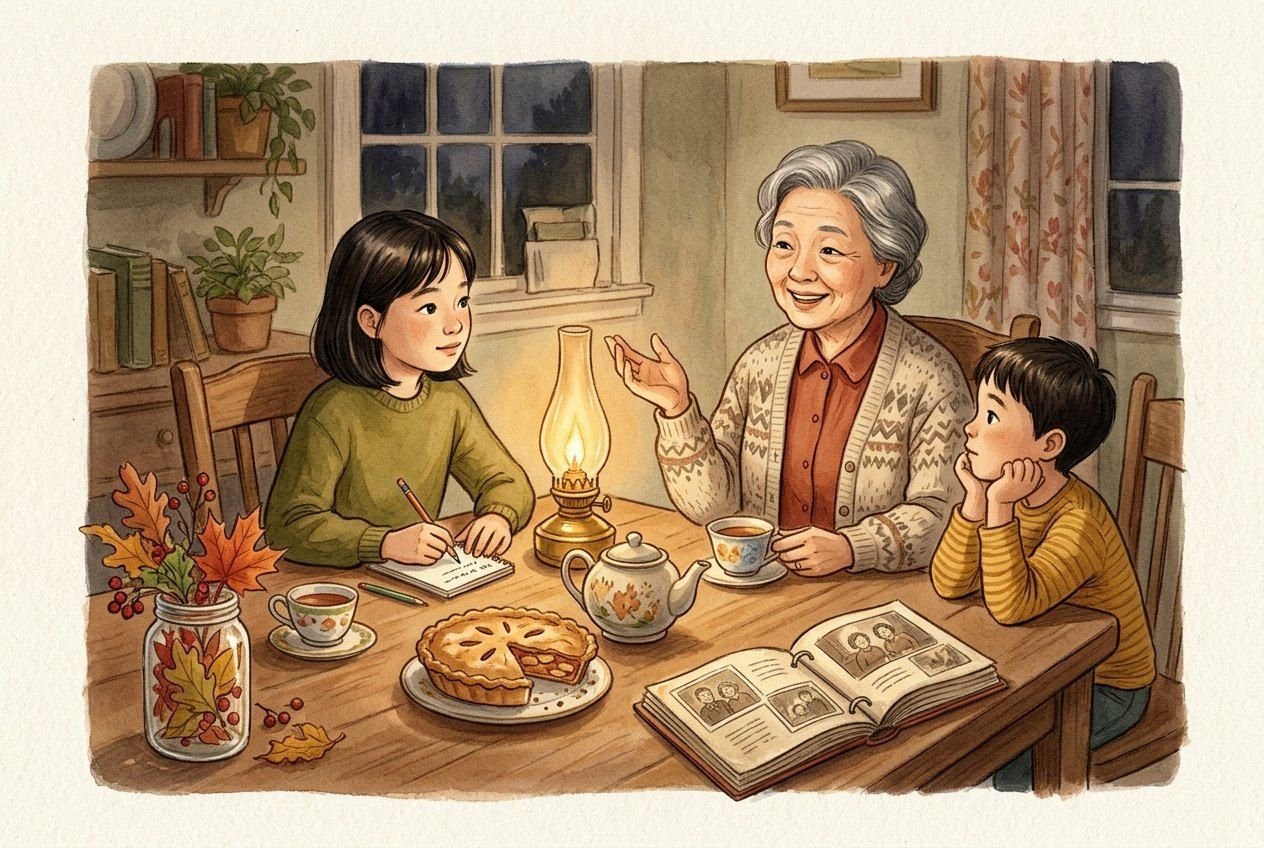
Thanksgiving week has four school days on the calendar and about two in real life. There are groceries to buy, a guest room to clear, a pie that has to cool before Thursday, and maybe a long drive. A homeschool Thanksgiving week rarely goes wrong because we did too little. It goes wrong because we tried to fit a full week of lessons around a holiday that needs the same table.
This plan goes the other way. Drop more, keep less, and let the holiday work do some of the teaching. The goal is not a perfect week. The goal is a family that reaches Thursday’s table with enough rest to enjoy one another.
Why Thanksgiving Week Feels So Crowded, and What to Drop
What makes this week so heavy? Three good things arrive at once: regular school, holiday preparation, and people, whether guests are coming to you or you are going to them. Each one is worth doing. Together they crowd out the very thing the holiday is for: time together.
So the question for this week is not “How do we get everything done?” It is “What can wait until December?” Most of it can.
Drop for this week:
- New concepts. Do not start long division on Tuesday. Use the short week to review what your children already know.
- Projects with many steps or a store run. A craft that needs three supplies you don’t own is a craft for another week.
- The catch-up push. If a unit is behind, one more crowded week will not fix it. A rested week might.
Keep:
- About 15 minutes of math practice each morning.
- Your read-aloud.
- One shared activity a day that brings everyone to the same table.
That is enough school for a holiday week. Notice what the list leaves room for: conversation.
A Light Four-Day Homeschool Plan for the Holiday Week
Thanksgiving falls on Thursday, November 26. Here is a simple shape for the days around it. Move the pieces to fit your family’s travel and guests.
Monday: a short normal day. Do math practice and your read-aloud in the morning. In the afternoon, plan the menu together. Each child writes one dish on an index card, and younger children draw it.
Tuesday: review and the shopping list. Keep the morning to review only. After lunch, build the grocery list from Monday’s cards. Older children add up prices and compare two brands. Younger children count items and sort the list by store section.
Wednesday: kitchen day. School happens at the counter. Measuring, reading a recipe, timing the oven, and cleaning up together are all lessons.
Thursday: Thanksgiving. No lessons. Bring the Table Talk questions in this post to the meal, and if grandparents are there, plan one story.
Friday: rest. If your children want something to do, give each one a single page: draw or write one thing they want to remember from the week. File it with your homeschool records.
Turn Holiday Prep into Learning: Kitchen Math, Reading, and Writing
A recipe is already a math lesson and a reading lesson. We only need to slow down enough to notice it.
Kitchen math
- Doubling and halving. Is the family bigger this year? Double the stuffing: ¾ cup of broth becomes 1½ cups. Halve a recipe for a smaller crowd: 1 cup of sugar becomes ½ cup.
- Elapsed time. “The pie bakes for 50 minutes. If it goes in at 2:15, when does it come out?” 3:05. Let a child set the timer and announce it.
- Money. Compare the price of a 5-pound bag of potatoes with two 3-pound bags. Which costs less per pound?
Reading. Let an older child read the recipe aloud while a younger one finds every number on the card. Reading for a purpose, so the rolls come out right, is still reading.
Writing. Children write the menu cards and a place card for each guest. On the back of each place card, they add one sentence of thanks for that person. On Friday, the same children can write two thank-you notes.
One activity for the whole table. Shaking cream into butter is a favorite because every age can take part. Fill a jar partway with heavy cream, close it tightly, and pass it around the table. The cream thickens into whipped cream, then separates into butter and buttermilk. The youngest children shake and describe what they hear; older ones keep time and record each stage.

Keep the hot oven and sharp knives with an adult. Children can measure, stir, read, time, and wash.
Table Talk That Builds Gratitude, Not Just a Thankful List
Going around the table to say what we are thankful for is a good tradition. But notice how quickly the list runs out: “my family, food, my house.” Those answers are true, but they are nouns. Gratitude grows when we name what someone did.
Compare two sentences:
- “I’m thankful for Grandma.”
- “I’m thankful Grandma drove two hours with the pie on her lap.”
The second one names a person, an act, and a cost. It is also something Grandma can hear and receive.
Try these four questions at the table instead of the usual round:
- Notice: What did someone at this table do for you this year?
- Why: Why do you think they did it?
- Connect: Who helped you this year who isn’t here today?
- Wonder: I wonder what God gave our family this year that we haven’t thanked Him for yet.
Let the youngest answer first, so older siblings don’t settle the question too quickly. Then wait. Silence is part of the activity. When a child answers, say “Tell me more” instead of “Good answer.”

If grandparents are at the table, hand the children the questions. Older relatives often have stories no one has asked for. A child might begin with:
- “What did Thanksgiving look like when you were my age?”
- “What was your first job?”
- “What is something you were thankful for that was hard at the time?”
A child with a notebook writes down one answer word for word. That one page may become the most valuable thing you file this year.
Keep the Connection Going After the Leftovers Are Gone
By the weekend the leftovers are mostly gone. The question is whether anything from the week stays.
It does not need to be much. Choose one:
- One question at dinner, once a week. Use any of the four above.
- A question jar on the table. Write ten questions on slips of paper and let a different child draw one each night.
- One screen-free hour on Sunday afternoon, spent on a single shared activity.
One small habit, kept every week, will do more than a big plan that lasts until Monday.
Psalm 128:3 pictures children “like olive plants round about thy table” (KJV). Olive shoots grow slowly, and they grow in one place. Around the table. That is where our children grow, and a slower Thanksgiving week is one way to give them more time there.